

PrimaryMirror#
- class esis.optics.PrimaryMirror(sag=None, num_folds=0, width_clear=<Quantity 0. mm>, width_border=<Quantity 0. mm>, material=None, translation=<Quantity 0. mm>, pitch=<Quantity 0. deg>, yaw=<Quantity 0. deg>, roll=<Quantity 0. deg>)[source]#
Bases:
AbstractPrimaryMirrorA model of the primary mirror of the instrument.
This mirror collects light from the Sun and focuses it onto the field stop.
Attributes
The optical material composing this object.
The order of the rotational symmetry of the optical system.
The pitch angle of this object.
The clear radius of the aperture from center to vertex.
The radius of the mechanical aperture from center to vertex.
The roll angle of this object
The sag function of this primary mirror.
Represent this object as an
optikasurface.the coordinate transformation between the global coordinate system and this object's local coordinate system
A transformation which can arbitrarily translate this object.
The width of the border around the clear aperture.
The width of the clear aperture from edge to edge.
The yaw angle of this object.
Methods
__init__([sag, num_folds, width_clear, ...])to_string([prefix])Public-facing version of the
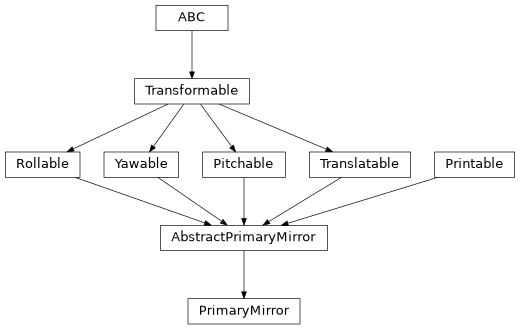
__repr__method that allows for defining a prefix string, which can be used to calculate how much whitespace to add to the beginning of each line of the result.Inheritance Diagram
- Parameters:
sag (None | AbstractSag)
num_folds (int)
width_clear (Quantity | AbstractScalar)
width_border (Quantity | AbstractScalar)
material (None | AbstractMaterial)
translation (Quantity | AbstractCartesian3dVectorArray)
pitch (Quantity | AbstractScalar)
yaw (Quantity | AbstractScalar)
roll (Quantity | AbstractScalar)
- to_string(prefix=None)#
Public-facing version of the
__repr__method that allows for defining a prefix string, which can be used to calculate how much whitespace to add to the beginning of each line of the result.
- material: None | AbstractMaterial = None#
The optical material composing this object.
- num_folds: int = 0#
The order of the rotational symmetry of the optical system. This is also the number of sides of the regular polygonal aperture.
- pitch: Quantity | AbstractScalar = <Quantity 0. deg>#
The pitch angle of this object.
- property radius_clear: Quantity | AbstractScalar#
The clear radius of the aperture from center to vertex.
- Raises:
ValueError – If the number of sides is not an even number.
- property radius_mechanical: Quantity | AbstractScalar#
The radius of the mechanical aperture from center to vertex.
- Raises:
ValueError – If the number of sides is not an even number.
- roll: Quantity | AbstractScalar = <Quantity 0. deg>#
The roll angle of this object
- sag: None | AbstractSag = None#
The sag function of this primary mirror.
- property transformation: AbstractTransformation#
the coordinate transformation between the global coordinate system and this object’s local coordinate system
- translation: Quantity | AbstractCartesian3dVectorArray = <Quantity 0. mm>#
A transformation which can arbitrarily translate this object.
- width_border: Quantity | AbstractScalar = <Quantity 0. mm>#
The width of the border around the clear aperture.
- width_clear: Quantity | AbstractScalar = <Quantity 0. mm>#
The width of the clear aperture from edge to edge.
- yaw: Quantity | AbstractScalar = <Quantity 0. deg>#
The yaw angle of this object.