

Filter#
- class esis.optics.Filter(material=None, radius_clear=<Quantity 0. mm>, width_border=<Quantity 0. mm>, distance_radial=<Quantity 0. mm>, azimuth=<Quantity 0. deg>, translation=<Quantity 0. mm>, pitch=<Quantity 0. deg>, yaw=<Quantity 0. deg>, roll=<Quantity 0. deg>)[source]#
Bases:
AbstractFilterA model of the visible-light filters of the instrument.
These are thin-film filters supported by a fine mesh.
Attributes
The angle of rotation about the axis of symmetry.
The distance of this object from the axis of symmetry.
A model of the filter material including the mesh and oxide.
The pitch angle of this object.
The radius of the filter's circular clear aperture.
The roll angle of this object
Represent this object as an
optikasurface.the coordinate transformation between the global coordinate system and this object's local coordinate system
A transformation which can arbitrarily translate this object.
The width of the frame around the clear aperture.
The yaw angle of this object.
Methods
__init__([material, radius_clear, ...])replace(**changes)A copy of this object with the given fields replaced.
to_string([prefix])Public-facing version of the
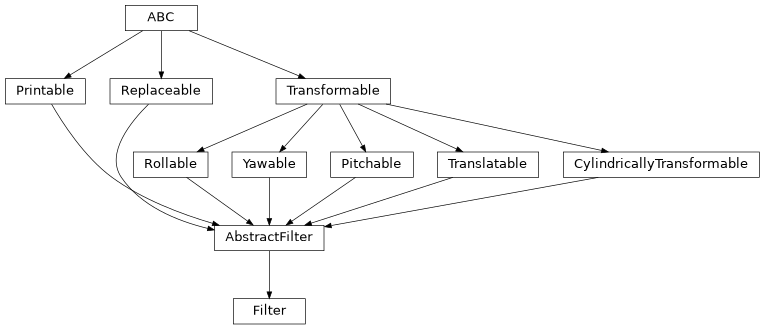
__repr__method that allows for defining a prefix string, which can be used to calculate how much whitespace to add to the beginning of each line of the result.Inheritance Diagram
- Parameters:
material (None | AbstractMaterial)
radius_clear (Quantity | AbstractScalar)
width_border (Quantity | AbstractScalar)
distance_radial (Quantity | AbstractScalar)
azimuth (Quantity | AbstractScalar)
translation (Quantity | AbstractCartesian3dVectorArray)
pitch (Quantity | AbstractScalar)
yaw (Quantity | AbstractScalar)
roll (Quantity | AbstractScalar)
- replace(**changes)#
A copy of this object with the given fields replaced.
A method version of
dataclasses.replace(), matchingnamed_arrays.AbstractArray.replace(), so that a nested change reads the same at every level:system.replace( surface=system.surface.replace( sag=system.surface.sag.replace(radius=r), ), )
The copy is shallow, as
dataclasses.replace()is: every field which is not named is shared with the original, and mutating one through the copy is mutating it in both. Takecopy.deepcopy()of the result where that matters.- Parameters:
changes – The fields to overwrite in the copy.
- Return type:
- to_string(prefix=None)#
Public-facing version of the
__repr__method that allows for defining a prefix string, which can be used to calculate how much whitespace to add to the beginning of each line of the result.
- azimuth: Quantity | AbstractScalar = <Quantity 0. deg>#
The angle of rotation about the axis of symmetry.
- distance_radial: Quantity | AbstractScalar = <Quantity 0. mm>#
The distance of this object from the axis of symmetry.
- material: None | AbstractMaterial = None#
A model of the filter material including the mesh and oxide.
- pitch: Quantity | AbstractScalar = <Quantity 0. deg>#
The pitch angle of this object.
- radius_clear: Quantity | AbstractScalar = <Quantity 0. mm>#
The radius of the filter’s circular clear aperture.
- roll: Quantity | AbstractScalar = <Quantity 0. deg>#
The roll angle of this object
- property transformation: AbstractTransformation#
the coordinate transformation between the global coordinate system and this object’s local coordinate system
- translation: Quantity | AbstractCartesian3dVectorArray = <Quantity 0. mm>#
A transformation which can arbitrarily translate this object.
- width_border: Quantity | AbstractScalar = <Quantity 0. mm>#
The width of the frame around the clear aperture.
- yaw: Quantity | AbstractScalar = <Quantity 0. deg>#
The yaw angle of this object.