
scene_iris#
- esis.flights.f1.data.synth.scene_iris(time_start, time_stop=None, wavelength_rest=<Quantity 629.732 Angstrom>, radiance=<Quantity 334.97 erg / (s sr cm2)>, fwhm=<Quantity 0.129 Angstrom>, axis_time='time', axis_detector_x='detector_x', axis_detector_y='detector_y', axis_velocity='velocity', velocity_max=<Quantity 300. km / s>, despike=True, background_removal=None, dn_min=<Quantity 8. DN>, dn_zero=<Quantity 0.01 DN>, **kwargs)[source]#
Create a synthetic scene of the \(\text{O\,V}\;630\,\AA\) spectral line.
IRIS spectroheliograms from a specified time range are shifted and scaled to the \(\text{O\,V}\;630\,\AA\) wavelength range to simulate a scene observed by ESIS.
- Parameters:
time_start (str | Time) – The start time of the IRIS observations.
time_stop (None | str | Time) – The ending time of the IRIS observations. If
None, one second is added to time_start, which usually has the effect of selecting a single observation.wavelength_rest (Quantity) – The new rest wavelength of the simulated scene. This replaces the actual rest wavelength of the IRIS observations.
radiance (Quantity) – The average radiance of the simulated scene. This replaces the actual radiance of the IRIS observations.
fwhm (Quantity) – The average full-width half maximum, in wavelength units, of the dominant spectral line in the simulated scene. The wavelength axis of the IRIS observations will be scaled to match this value.
axis_time (str) – The logical axis corresponding to changes in time.
axis_detector_x (str) – The logical axis corresponding to changes in detector \(x\)-coordinate.
axis_detector_y (str) – The logical axis corresponding to changes in detector \(y\)-coordinate.
axis_velocity (str) – The logical axis corresponding to changes in line-of-sight velocity.
velocity_max (None | Quantity) – The maximum doppler velocity of the simulated scene. Values outside this range are cropped.
despike (bool) – Whether to remove cosmic ray spikes using
astroscrappy.background_removal (None | Literal['trim_mean']) – The background removal algorithm to remove stray light. Currently, the options are
None(the default) which is no background removal, andtrim_meanwhich uses a trimmed mean to estimate a constant background value.dn_min (Quantity) – To prevent negatives in the final scene without biasing areas with zero flux, pixels with a value less than dn_min will be set to dn_zero.
dn_zero (Quantity) – If a pixel truly has zero flux, this presents a problem since the uncertainty of this pixel is infinite. To prevent this, we interpret “zero flux” as a very small number called dn_zero.
kwargs – Additional keyword arguments passed to
iris.sg.open()
- Return type:
FunctionArray[TemporalDopplerPositionalVectorArray, ScalarArray]
Examples
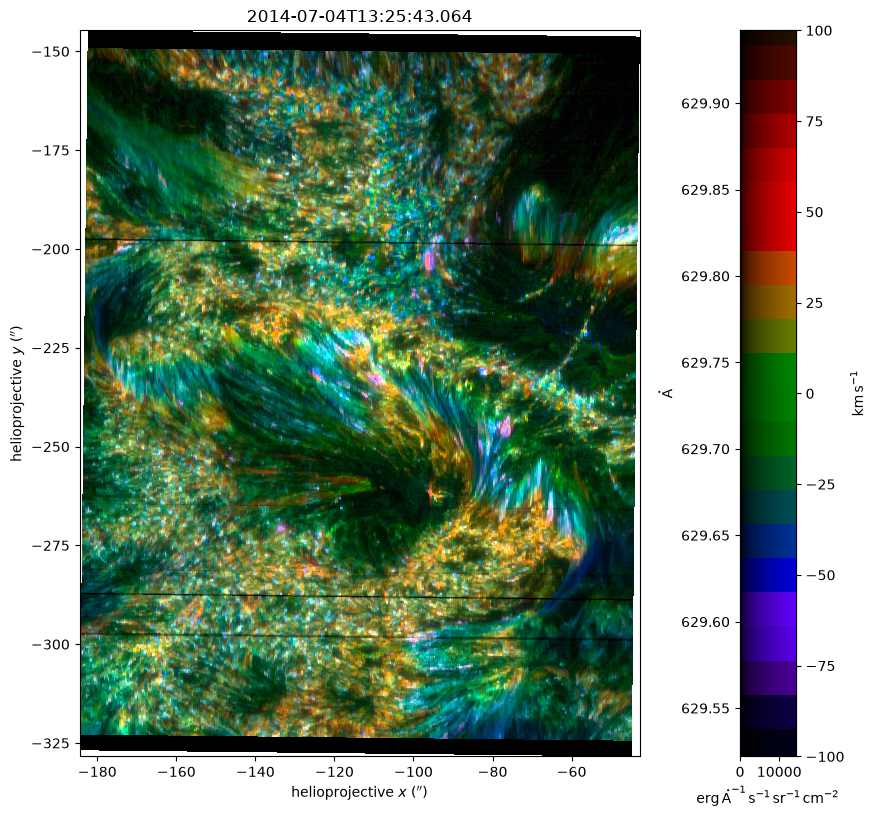
Load a synthetic \(\text{O\,V}\;630\,\AA\) scene and display it as a false-color image.
import esis

scene = esis.flights.f1.data.synth.scene_iris("2014-07-04 11:40")

scene.show();
References to
esis.flights.f1.data.synth.scene_iris